
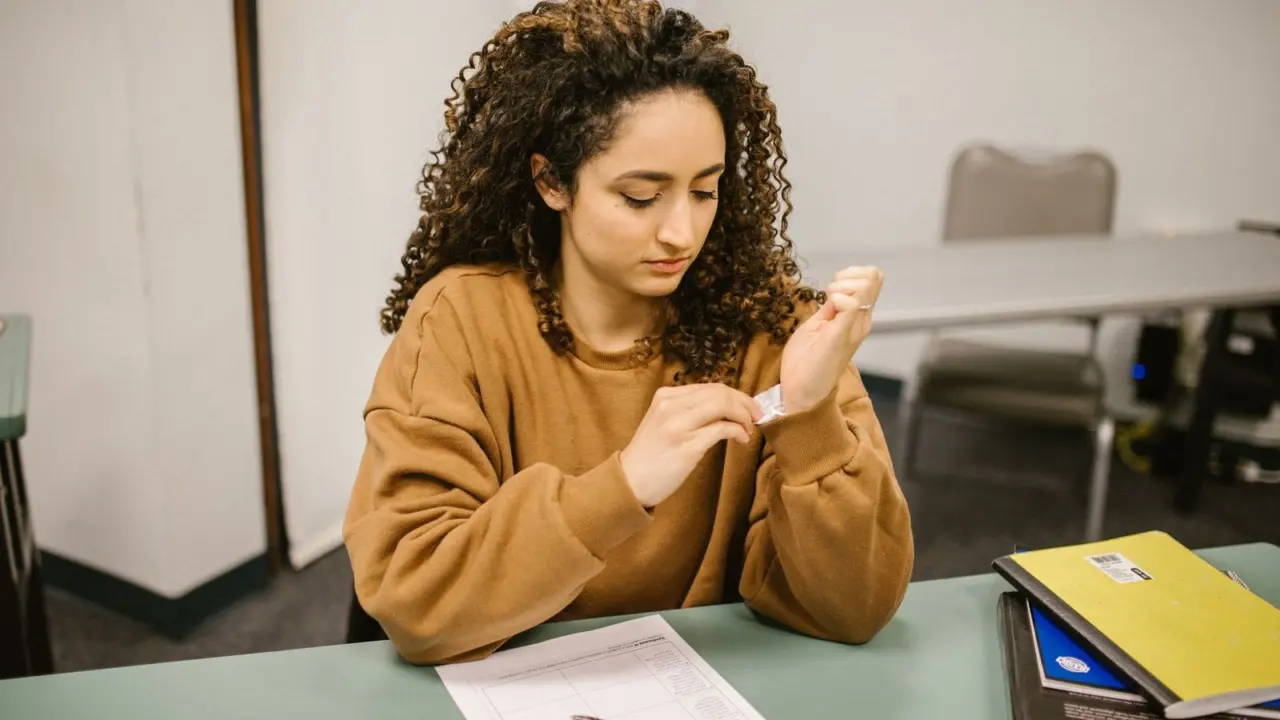
Reading your notes again feels productive, but it may not stick. The active recall technique, closing the book and testing yourself, builds more durable memory than rereading, according to testing-effect research.
This guide sits inside the study skills section of the site, alongside other methods for revising smarter.
| Item | Value |
|---|---|
| Transfer across test formats (Pan & Rickard, 2018) | Effect size d=0.58 (medium-large) |
| Retrieval practice compared with re-reading (Roediger, 2006) | More durable long-term memory |
| Test format with the stronger effect (Kang et al., 2007) | Production tests (short answer, essay) over multiple choice / true-false |
| Immediate tests | Testing effect may be diminished or inverted |
| Practice without feedback | May be less effective |
These figures come from Andy Matuschak’s notes on the testing effect, which summarise published studies. Findings and figures can change, so check the source before you rely on them.
What is the active recall technique?
Active recall means pulling information out of your memory instead of looking at it. Writing down everything you remember about a chapter with the book closed is active recall; reading the chapter a second time is not.
Researchers call the benefit the testing effect. When you try to recall some detail from memory, that act strengthens your memory of that detail, and used as a learning activity it is called retrieval practice.
You can practise it in many ways:
- Flashcards with a question on one side and the answer on the other.
- A blank-page dump of everything you remember about a topic.
- Past-paper style questions answered without notes.
- Turning each heading in your notes into a question and answering it from memory.
Why testing yourself works better than rereading
In typical classrooms, teachers and students imagine that learning happens during lectures or while reading, and that tests only assess it. The notes argue the opposite: the tests themselves are an important part of the learning process.
The notes cite Roediger (2006) for the finding that retrieval practice leads to more durable long-term memory than simply re-reading. The catch is that students are less successful during the practice itself. So if recall feels harder than rereading, that is not a sign it is failing.
The same notes mention Karpicke and Smith (2012) and Karpicke and Blunt (2011). Relative to elaborative practice alone, retrieval seems to lead to more durable memory and improved learning performance in general.
The effect is not limited to one subject or one age group. It has been demonstrated in many fields and at many age levels, and a 2021 review by Agarwal and colleagues is titled “Retrieval Practice Consistently Benefits Student Learning”.
How to practise active recall step by step
You do not need special tools. A pen, paper and your existing notes are enough to run a proper recall session.
- Choose a small chunk of material, such as a single topic or a few pages.
- Study it once in your usual way.
- Close the book and write or say everything you can remember, without peeking.
- Open your notes and compare. Mark what you missed or got wrong.
- Turn each gap into a question and test yourself on those questions later.
Step four matters more than it looks. The notes say the testing effect has been shown even when the correct answer is not provided, but also that retrieval practice may be less effective without feedback. Checking your answers is the simple way to stay on the safe side.
Keep the first attempts short. A messy, half-empty page tells you exactly where to focus next, which is the whole point.
Choosing question formats that suit your exam
Not every kind of question gives the same boost. The testing effect is generally measured to be more pronounced for production tests such as short answer and essay than for discrimination tests such as multiple choice or true-false (Kang et al., 2007).
That suggests spending most of your time on questions where you have to produce an answer rather than recognise one. Multiple choice still has a place, but it should not be your only practice.
Format matching helps too. The notes describe Agarwal’s 2019 work as finding that matched practice and test modalities generally do best, with mixed practice a possible compromise. In plain terms, if your exam is written, practise by writing.
There is also encouraging evidence that practice carries over. Pan and Rickard (2018) find a medium-large effect (d=0.58) for transfer across initial and final test formats, so a different practice format is not wasted effort.
Prompts that work well for production practice include:
- “Explain this idea in your own words.”
- “List the causes, steps or stages of this process.”
- “What is the difference between these two terms?”
- “Give an example and say why it fits.”
Write your answers in full sentences where you can. Vague, half-formed answers are easy to hide in your head but hard to hide on paper.

Mistakes that weaken active recall
Most problems come from making the practice too comfortable. Watch for these habits:
- Peeking too soon. If you glance at the answer before you have tried, you are back to rereading.
- Skipping feedback. Without checking, errors can stay in your memory unnoticed.
- Testing straight after studying. The notes say the testing effect may be diminished or inverted for immediate tests, so leave a gap before you quiz yourself.
- Using only recognition questions. Production questions show stronger effects.
- Quitting because it feels hard. Struggling during practice is normal.
If you notice yourself doing any of these, change one thing at a time. A small fix, such as covering the answer side of your flashcards, is usually enough.
Fitting active recall into your week
Active recall works best as a routine, not a one-off. Once you know how to make a study timetable, you can give each subject a short, regular recall slot next to your reading time.
You can also spread those tests out over days and weeks. A guide to spaced repetition for students explains how to decide when to revisit each topic.
A simple weekly pattern might look like this:
- After a class: a short blank-page recall of what you just covered, once enough time has passed that it is not fresh in your head.
- Midweek: written questions on last week’s topics, answered without notes.
- Weekend: a mixed set of questions from several subjects, checked against your notes.
This site is an independent educational resource and is not affiliated with any school, board or exam body. Use the ideas here as a starting point and adapt them to your own subjects and syllabus.
Frequently asked questions
Is active recall the same as retrieval practice?
Show answer
In practice, yes. The notes describe trying to recall a detail from memory as strengthening that memory, and call it retrieval practice when it is used as a learning activity.
Does active recall work if I cannot check the answer?
Show answer
The notes say the effect has been demonstrated even when the correct answer is not provided. They also say retrieval practice may be less effective without feedback, so checking your answers is worth the extra minute.
Should I quiz myself right after studying?
Show answer
It is better to leave a gap. The notes say the testing effect may be diminished or inverted for immediate tests.
Why does active recall feel harder than rereading?
Show answer
Students tend to be less successful during retrieval practice than during re-reading, yet it leads to more durable long-term memory, according to the notes citing Roediger (2006). The difficulty is part of how it works.